You've probably talked to a chatbot at least once this week. Maybe you asked a question on a brand's website and got a response that felt like it was written by a robot who had never met a human before.
"I'm sorry, I didn't understand that. Please select one of the options below."
And then you clicked the little X and gave up.
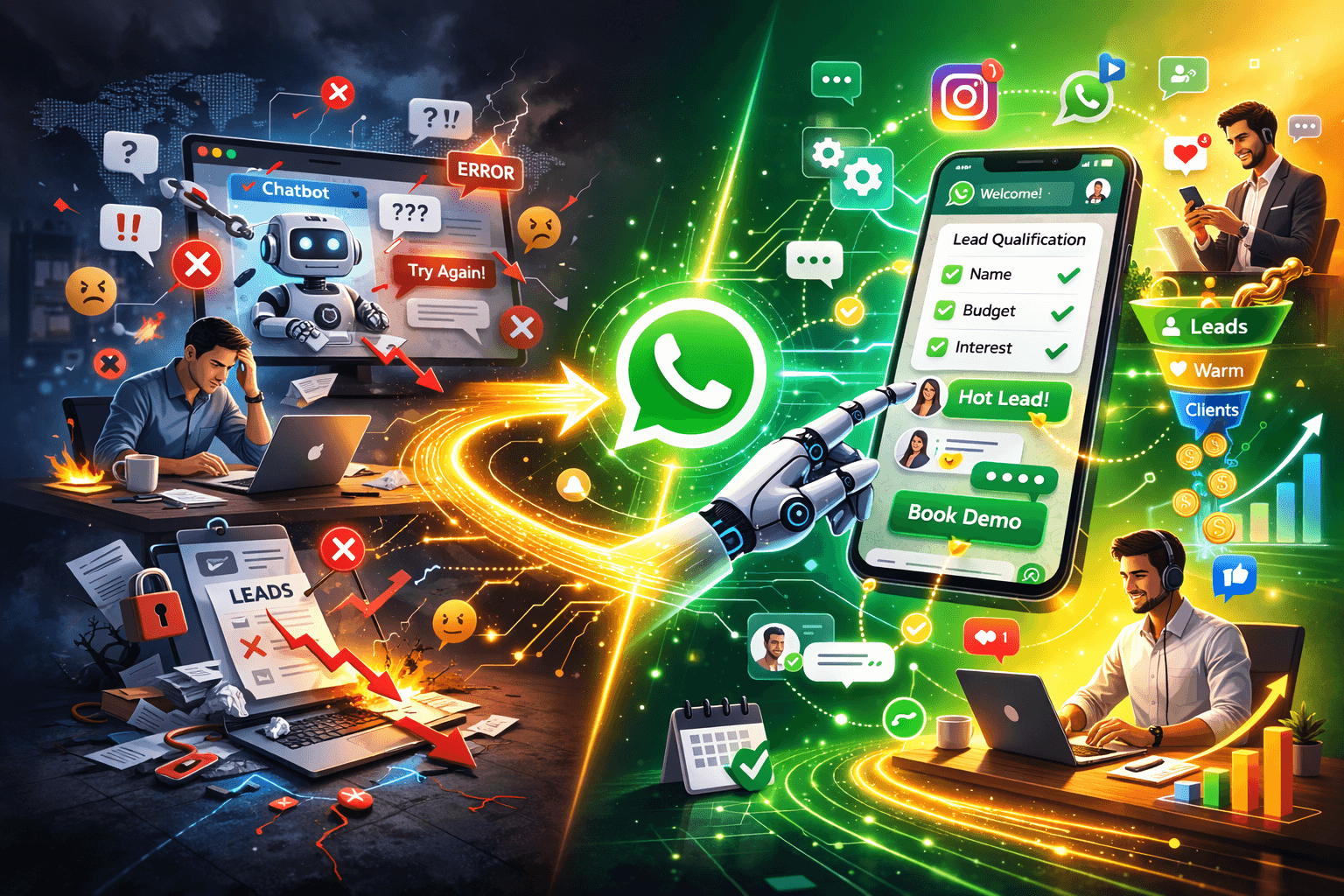
That's the chatbot experience most people know. And it's exactly why businesses all over the world, including thousands in India, are quietly moving away from traditional chatbots and switching to smarter chatbot alternatives built on real automation workflows and conversational marketing.
Let's talk about why this shift is happening, what's replacing chatbots, and what that means for your business.
The Chatbot Promise vs. The Chatbot Reality
When chatbots first came out, the pitch was exciting. Set it up once, automate your customer support, never miss a lead. Businesses spent lakhs building chatbot flows, embedding them on websites, and training support teams to hand off to them.
Then reality hit.
Customers hated the experience. The bots couldn't understand anything outside their script. One wrong word and the whole conversation broke down. And because the bot lived on a website widget, customers had to go out of their way to even find it.
The core problem? Chatbots were built to simulate conversation, not to actually serve customers. They were scripted to follow a rigid decision tree. The moment a customer went off-script, which is literally what every real customer does, the bot fell apart.
And here's the thing nobody talks about: chatbot abandonment rates are brutal. Studies show that over 50% of users abandon chatbot conversations before getting a resolution. That means half your leads are walking away frustrated.
Why Traditional Chatbots Are Failing Businesses in 2026
It's not that automation is bad. It's that the old chatbot model was built for the wrong channel, with the wrong logic.
Here's where chatbots specifically fall short:
They live where nobody wants to be. A website chatbot requires someone to visit your site, notice the widget, click it, and then wait for it to load. Most people don't do this. They bounce before the bot even opens.
They're rigid and unforgiving. Traditional chatbots follow strict if-this-then-that logic. There's no flexibility. If a user types "I want to know about your pricing" instead of clicking the "Pricing" button, many bots just throw an error.
They don't integrate well with anything. Most older chatbot tools are islands. They don't talk to your CRM, they don't update your team in real time, and they definitely don't connect to WhatsApp or Instagram where your customers actually are.
They create a cold experience. People can tell when they're talking to a bot. And they don't like it. They want to feel heard, not routed.
What Businesses Are Switching To: Automation Workflows on Messaging Apps
The real shift happening in 2026 isn't from chatbots to human agents. That would be too expensive and doesn't scale. The shift is from chatbots on websites to intelligent automation workflows on messaging platforms like WhatsApp and Instagram.
This is a fundamentally different approach, and it works for a simple reason: you're meeting customers where they already are.
Think about it. Your customer is already on WhatsApp. They use it to talk to their family, their friends, their colleagues. When a business reaches out on WhatsApp, it feels natural. It doesn't feel like a support ticket. And when the conversation is automated smartly, it feels like talking to a helpful team member, not a bot reading from a script.
This is what conversation automation actually looks like in practice. Not a rigid chatbot. A smart, flexible messaging flow that guides users, qualifies leads, answers questions, and hands off to humans only when it needs to.
Automation Workflows vs. Chatbots: What's the Actual Difference?
Here's a quick comparison to make this concrete:
|
Feature |
Traditional Chatbot |
Automation Workflows |
|
Where it lives |
Website widget |
WhatsApp, Instagram, SMS |
|
Flexibility |
Rigid, script-based |
Adaptive, context-aware |
|
CRM integration |
Often siloed |
Native sync with CRM |
|
Open/engagement rate |
Low (depends on site traffic) |
80-90% on WhatsApp |
|
Handoff to human |
Clunky, often broken |
Smooth and contextual |
|
Lead qualification |
Limited |
Built-in and automated |
|
Customer experience |
Frustrating |
Feels like a real conversation |
The difference isn't just technical. It's the entire experience from the customer's point of view.
Conversational Marketing: The Strategy Behind the Switch
There's a term for what businesses are moving toward: conversational marketing. The idea is simple. Instead of sending people to a landing page and hoping they fill a form, you start a real conversation with them on a channel they trust.
And messaging is now replacing landing pages for exactly this reason. A form is passive. A conversation is active. When someone replies to your WhatsApp message, they're already engaged. That engagement carries through the whole journey.
Conversational marketing doesn't just improve the customer experience. It improves your numbers. Businesses using WhatsApp-based automation workflows are seeing response rates 3-4x higher than their old website chatbot setups.
Real Examples of What's Working Right Now
Small Businesses Ditching Website Bots for WhatsApp
A Delhi-based coaching institute tried a website chatbot for six months. They got a handful of leads. The bot couldn't answer anything specific, and parents who came to inquire just left the site.
They switched to WhatsApp automation. Now, when someone clicks their Instagram ad, they get a WhatsApp message instantly. The automation asks about their child's grade, their specific needs, and their preferred batch timing. The institute's team gets a qualified lead with full context. Conversions went up by over 60% in the first month.
Freelancers Replacing Back-and-Forth Emails
Freelancers waste so much time on repetitive communication. Sending project updates, chasing approvals, confirming deadlines. A lot of them have moved this entirely to WhatsApp automation. Automating client communication on WhatsApp means automated reminders, payment follow-ups, and project status messages, without sounding robotic.
E-commerce Brands Using Instagram DM Automation
Instagram is where people discover products. But discovery doesn't mean purchase. The gap between "I like this" and "I bought this" is where most e-commerce brands lose customers.
Instagram DM automation closes that gap. When someone comments on a post or replies to a story, an automated DM fires instantly with a direct link, a discount code, or a product recommendation. No chatbot. No form. Just a natural message in the place they're already spending time.
What to Look for in a Chatbot Alternative
If you're ready to move away from your old chatbot setup, here's what a good alternative actually needs:
It has to be on WhatsApp or Instagram. These are the channels with the highest engagement. If your automation isn't where your customers are, it won't work.
It needs to connect to your CRM. This is non-negotiable. Every conversation, every qualified lead, every customer reply needs to feed into your existing system automatically. This is how messaging-first CRM actually works in practice.
It should support broadcast campaigns. Beyond just responding to inbound messages, you need to be able to proactively reach your audience. WhatsApp broadcast campaigns let you send targeted messages to segmented lists, with automation that handles the replies.
It should allow for human takeover. The best automation workflows know when to step aside. When a conversation gets complex, a real person should be able to jump in with full context, without the customer having to repeat themselves.
Bonus: Get verified. Businesses that have WhatsApp Blue Tick verification see noticeably higher open rates and trust signals. If you're scaling your WhatsApp presence, this is worth pursuing.
FAQs: Moving Away from Chatbots
Are chatbots completely dead? Not completely. AI-powered chatbots using large language models are a different story and still have use cases. But the traditional rule-based chatbot sitting on your website? That model is genuinely fading out.
Is WhatsApp automation the same as a chatbot? No, and this is an important distinction. WhatsApp automation uses intelligent workflows that adapt to user inputs, connect to your CRM, and support human handoff. A chatbot typically follows a fixed script and lives on your website.
Is WhatsApp automation expensive to set up? It's much more affordable than maintaining a chatbot platform plus a support team. Most automation platforms offer plans that make sense even for small businesses.
Can I run automation on both WhatsApp and Instagram at the same time? Yes. If you're trying to decide between the two, check out WhatsApp vs Instagram automation to figure out which one to prioritize based on where your audience is.
What if my customers prefer email? Some industries still rely on email. But if you've never tested WhatsApp with your audience, you're probably assuming based on old data. Try running a parallel campaign and see which channel gets better responses.
How quickly can I switch from a chatbot to automation workflows? Most businesses are up and running in under a week. You don't need a developer or a big tech team. The setup is mostly about mapping your customer journey and building the conversation flow, which a good automation platform will walk you through.
The Bottom Line
Chatbots had their moment. But they were built for a different era of the internet, one where people tolerated clunky digital experiences because there wasn't a better option.
That option exists now. Automation workflows on WhatsApp and Instagram deliver better experiences, better response rates, and better ROI than any website chatbot ever could.
The businesses moving fast on this are already seeing the results. The ones still hoping their website bot will improve are losing leads to competitors every single day.
If you're ready to move your customer conversations to a platform that actually works, talk to the Wasupp team and we'll help you build the right automation workflow for your business