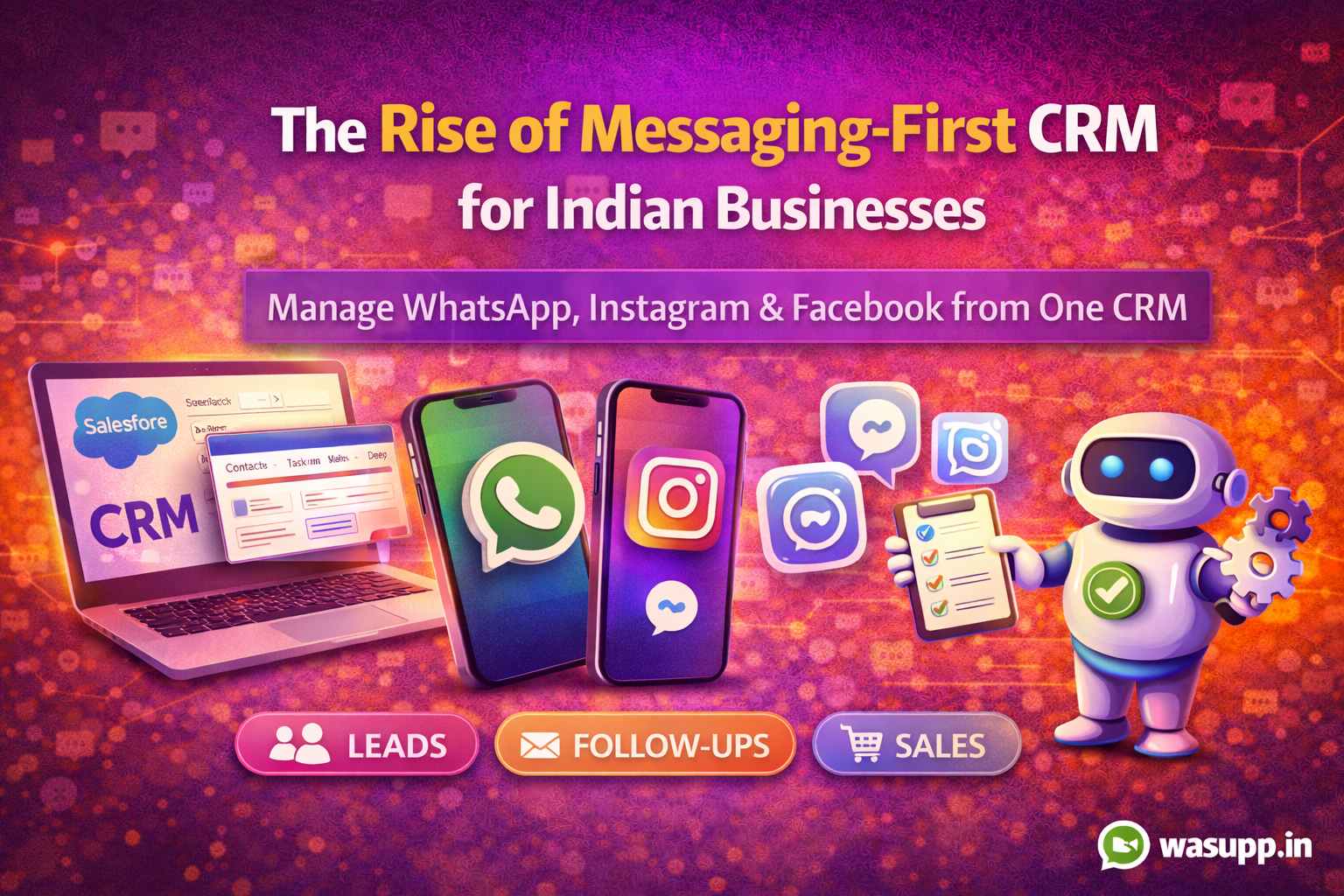
Your sales team is using Salesforce. Your customers are on WhatsApp.
See the problem?
Traditional CRMs were built for email and phone calls. But in India, nobody checks email religiously, and cold calls get ignored. Your customers live on WhatsApp, Instagram, and Facebook Messenger.
So why are you still managing customer relationships in a tool that doesn't connect to where those relationships actually happen?
This disconnect is why messaging-first CRM is exploding in India right now. It's not replacing traditional CRM. It's fixing what traditional CRM gets wrong for how Indians actually communicate.
Let me show you why this shift matters and what it means for your business.
What Is Messaging-First CRM?
A messaging-first CRM is exactly what it sounds like. It's customer relationship management software built around messaging platforms instead of email and phone.
Instead of logging calls and emails, you're managing WhatsApp conversations, Instagram DMs, and Facebook messages. All in one place.
Traditional CRM thinking: "Let me log this customer's details, then send them an email, then wait for them to call back."
Messaging CRM thinking: "This customer just messaged us on WhatsApp. Let me see their conversation history, tag them appropriately, and continue the conversation right here."
One lives in the past. The other lives where your customers actually are.
Why Traditional CRMs Don't Work for Indian Businesses
Let's be honest about something most businesses won't admit: they bought an expensive CRM, got excited for two weeks, then slowly stopped using it.
Sound familiar?
Here's why traditional CRMs fail in India:
Indians Don't Use Email the Same Way
In Western markets, email is still the primary business communication channel. In India? People check email maybe once a day, if that.
WhatsApp, on the other hand, gets checked every few minutes. When you send someone an email, you're hoping they see it eventually. When you message them on WhatsApp, you know they'll see it within the hour.
Traditional CRMs were built for email-first communication. That model doesn't fit how Indians actually operate.
The Setup Is Too Complicated
You buy a traditional CRM. Then you need to:
- Configure dozens of settings
- Train your entire team
- Integrate with your existing tools
- Create custom fields and workflows
- Hire a consultant to set it up properly
By the time it's ready, three months have passed and your team has lost interest.
Messaging CRMs are simpler. Connect your WhatsApp Business account. Start managing conversations. That's it.
Your Team Won't Actually Use It
Your sales team is already on WhatsApp talking to customers all day. You're asking them to also log every interaction in a separate CRM system.
They do it for the first week because you're watching. Then they stop because it's extra work.
With messaging-first CRM, there's nothing extra to do. The conversations are already in the system because they're happening in the system.
It Doesn't Match Real Customer Journeys
Traditional CRM assumes a linear path: lead, opportunity, quote, closed deal.
But real customer journeys in India look more like this:
- Someone messages you on Instagram about a product
- You move them to WhatsApp for details
- They go quiet for a week
- They message you again from a different number
- You finally close the deal three weeks later across four platforms
Traditional CRMs weren't designed for this messy, multi-channel reality. Messaging CRMs are.
Why Messaging CRM Makes Sense for India
India has over 500 million WhatsApp users. Instagram has 230+ million Indian users. These platforms aren't just for personal chat. They're where business happens.
WhatsApp Is Your Customer's Default
When someone wants to contact a business in India, their first instinct isn't to fill out a contact form or send an email. It's to check if you're on WhatsApp.
"Send me your WhatsApp number" is basically the new "What's your email?"
If your CRM doesn't connect to WhatsApp, it's not connected to where your actual customer relationships live.
Speed Matters More Than Ever
Indian customers expect instant responses. If you take 2 hours to reply, they've already moved on to your competitor.
Messaging CRM helps your team respond faster because:
- All conversations are in one dashboard
- Team members can see who's handling what
- Auto-replies keep customers engaged while you craft proper responses
- Templates speed up common responses
Context Is Everything
Here's a common scenario: A customer messages you on WhatsApp. Your sales person replies. Two days later, the customer messages again, but a different team member sees it.
That team member has no idea about the previous conversation. The customer has to repeat everything. Frustration builds.
With messaging CRM, anyone on your team can see the full conversation history instantly. Complete context, every time.
Multi-Channel Is the Reality
Your customers don't live on just one platform. They might:
- Discover you on Instagram
- Message you there with questions
- Move to WhatsApp for serious discussion
- Order through your website
- Follow up via Facebook Messenger
Traditional CRMs don't handle this well. You're jumping between tools, losing context, and missing messages.
Messaging-first CRMs aggregate all these channels in one place. You see the complete customer journey, regardless of which platform they used.
What Makes a Good Messaging CRM?
Not all messaging CRMs are created equal. Here's what actually matters for Indian businesses:
WhatsApp Business API Integration
This is non-negotiable. You need proper WhatsApp Business API access, not just the free WhatsApp Business app.
The API gives you:
- Unlimited agents handling conversations
- Automation and chatbots
- Broadcasting to thousands of customers
- Integration with your other tools
- Analytics and reporting
Multi-Channel Inbox
You should see WhatsApp, Instagram, Facebook, and other channels in one unified inbox. No switching between apps or tabs.
When a customer messages you, you see their message along with their entire history across all platforms.
Contact Management
Just like traditional CRM, you need to:
- Store customer details
- Add tags and custom fields
- Segment customers into groups
- Track purchase history
- See interaction timeline
But it should happen automatically based on conversations, not manual data entry.
Team Collaboration
Multiple people need to handle customer conversations without stepping on each other's toes.
Good messaging CRMs include:
- Assignment features (who's handling which conversation)
- Internal notes (team members can discuss customers privately)
- Conversation handoffs (sales to support, for example)
- Performance metrics per team member
Automation Without Losing the Human Touch
You want automation to handle repetitive stuff:
- Initial greetings
- FAQs
- Lead qualification questions
- Follow-up reminders
- Appointment confirmations
But you also need easy ways for humans to jump in when needed. The best messaging CRMs make this seamless.
Analytics That Actually Matter
Forget vanity metrics. You need to know:
- Response time (are you replying fast enough?)
- Resolution time (how long to close conversations?)
- Conversion rate (messages to sales)
- Customer satisfaction
- Team performance
If your CRM can't show you this, it's just a glorified chat app.
Real Example: How a Mumbai Business Switched to Messaging CRM
Let me tell you about Arjun. He runs a home decor business in Mumbai with a team of five.
Before messaging CRM:
They were using a traditional CRM that cost 15,000 rupees per month. Here's what their process looked like:
- Customer messages on Instagram asking about a mirror
- Sales person replies on Instagram
- Manually copies customer name and email into CRM
- Sends product catalog via Instagram
- Customer asks follow-up questions
- Sales person has to search through Instagram DMs to find conversation history
- Customer wants to buy, moves to WhatsApp
- Now there are two conversation threads to track
- Sales person updates CRM manually (sometimes forgets)
- No one else on the team can see full conversation context
Result: Lost messages, frustrated customers, and a CRM that felt like extra work instead of helpful.
After switching to messaging CRM:
- Customer messages on Instagram asking about a mirror
- Message appears in team's unified inbox
- Automation asks qualifying questions, captures details automatically
- Sales person sees complete conversation, customer details, and browsing history
- Sends catalog and continues conversation
- Customer moves to WhatsApp? No problem. Same inbox, same context
- When customer is ready to buy, payment link sent via WhatsApp
- Order confirmation automated
- Delivery updates automated
- Post-delivery follow-up automated
- All of this tracked and recorded automatically
Result: Arjun's team handles 3x more customers with the same team size. Response time dropped from 2 hours to 5 minutes. Sales increased 40% in three months.
Same team. Same products. Just better tools.
How Messaging CRM Helps Different Business Types
This isn't just for one type of business. Messaging CRM works across industries.
E-Commerce Brands
You need to handle:
- Product inquiries
- Order confirmations
- Shipping updates
- Returns and exchanges
- Abandoned cart recovery
Messaging CRM automates the routine updates while giving your team context to handle complex issues quickly.
Service Businesses
Salons, clinics, consultants, repair services. You're booking appointments, sending reminders, and following up.
Messaging CRM connects your calendar, handles bookings via WhatsApp, and reduces no-shows with automated reminders.
Real Estate
You're juggling dozens of potential buyers, each at different stages of the journey. Some are just browsing. Others are ready to visit properties.
Messaging CRM keeps track of everyone, automates follow-ups, and ensures hot leads don't slip through the cracks.
Education and Coaching
Course inquiries, admissions, doubt-clearing, attendance updates. All happening across WhatsApp and Instagram.
Messaging CRM organizes the chaos and automates the administrative burden.
Restaurants and Food Delivery
Table bookings, takeaway orders, special requests, feedback collection. All through messaging.
Messaging CRM handles high volumes during rush hours without missing orders or double-booking tables.
Making the Switch from Traditional CRM
If you're already using a traditional CRM, switching sounds scary. It doesn't have to be.
You Don't Have to Abandon Everything
Most messaging CRMs integrate with traditional CRMs. You can run both simultaneously and gradually migrate.
Start by handling new messaging conversations in the messaging CRM. Keep historical data in your old system until you're ready to fully switch.
Your Team Will Actually Adopt This One
The biggest CRM problem is adoption. You invest in software nobody uses.
Messaging CRM has high adoption rates because your team is already on these platforms. You're not asking them to learn something new. You're just organizing what they're already doing.
The ROI Is Immediate
Traditional CRMs take months to show value. Messaging CRM shows value immediately:
- Day 1: Faster response times
- Week 1: Better team coordination
- Month 1: More closed deals
- Month 3: Clear patterns in customer behavior
You'll see results before your first month's subscription ends.
Migration Is Simpler Than You Think
Most businesses overthink this. Here's the real process:
- Connect your messaging channels (WhatsApp, Instagram, etc.)
- Set up basic automation for common questions
- Add your team members
- Start handling new conversations in the messaging CRM
- Gradually build out more advanced features
You're operational in days, not months.
The Future Is Messaging-First
Here's what's happening: every week, more Indian businesses realize that email-first CRM doesn't match reality.
The companies growing fastest are the ones meeting customers where they already are. On messaging platforms.
Traditional CRMs still have their place for complex B2B sales cycles or industries where email dominates. But for most Indian businesses selling to Indian customers? Messaging-first CRM is the smarter choice.
It's faster to implement. Easier to use. Matches customer behavior. And actually gets adopted by your team.
The question isn't whether messaging CRM makes sense. The question is how much longer you're going to force-fit Western tools onto Indian customer behavior.
Ready to see what messaging-first CRM could do for your business? Let's talk about building a system that actually works for how your customers communicate.
FAQs
Is messaging CRM a replacement for traditional CRM?
It depends on your business. For most Indian SMBs selling to local customers, yes, messaging CRM can replace traditional CRM entirely. For enterprises with complex sales processes or global operations, messaging CRM works better as a complement to traditional CRM.
How much does messaging CRM cost?
Pricing varies by platform and features, but most messaging CRMs for small businesses run between 2,000 to 10,000 rupees per month. Some charge per user, others per conversation. Generally cheaper than enterprise CRMs like Salesforce.
Can I connect multiple WhatsApp numbers?
Yes, most messaging CRMs allow multiple WhatsApp Business accounts. This is useful if you have different numbers for sales, support, or different product lines.
What happens to my data if I switch platforms?
Good messaging CRMs let you export your data. Before committing, confirm the platform supports data export and check what format it uses. Most support CSV or API access for data migration.
Do I need technical skills to set this up?
No. Most modern messaging CRMs are no-code platforms. If you can use WhatsApp and drag-and-drop, you can set up a messaging CRM. Some advanced features might need help, but basic setup is straightforward.
Can messaging CRM handle high volumes?
Share this post