Every missed call is a lead you almost had.
Think about that for a second. Someone saw your ad, found your number, worked up the motivation to actually call you, and then got a busy tone or no answer. That person was interested. Maybe very interested. And then silence from your end.
Most businesses treat missed calls as a minor inconvenience. The reality is that for small and medium businesses in India, missed calls are one of the biggest untracked revenue leaks in the entire operation.
But here is the thing. With the right missed call automation setup, every single one of those missed calls can become a WhatsApp lead within seconds, without you or your team having to call anyone back manually.
This is how it works, why it works so well in the Indian market specifically, and how you can set it up for your business right now.
Why Missed Calls Are Such a Big Deal in India
India has a very unique communication culture when it comes to missed calls. A missed call is not always an accident here. People use missed calls deliberately to signal interest, request a callback, or initiate contact without spending money on the call itself.
If you have ever run a "give a missed call to know more" campaign, you already know how powerful this behavior is. Businesses in telecom, education, real estate, and financial services have been using missed call campaigns for years because they work. The barrier to action is almost zero. No form to fill. No email to type. Just one tap.
The problem has always been the follow-up. A missed call comes in. Someone has to notice it, find the number, call back, hope the person picks up, explain who you are, and then start the actual conversation. That process is slow, inconsistent, and does not scale.
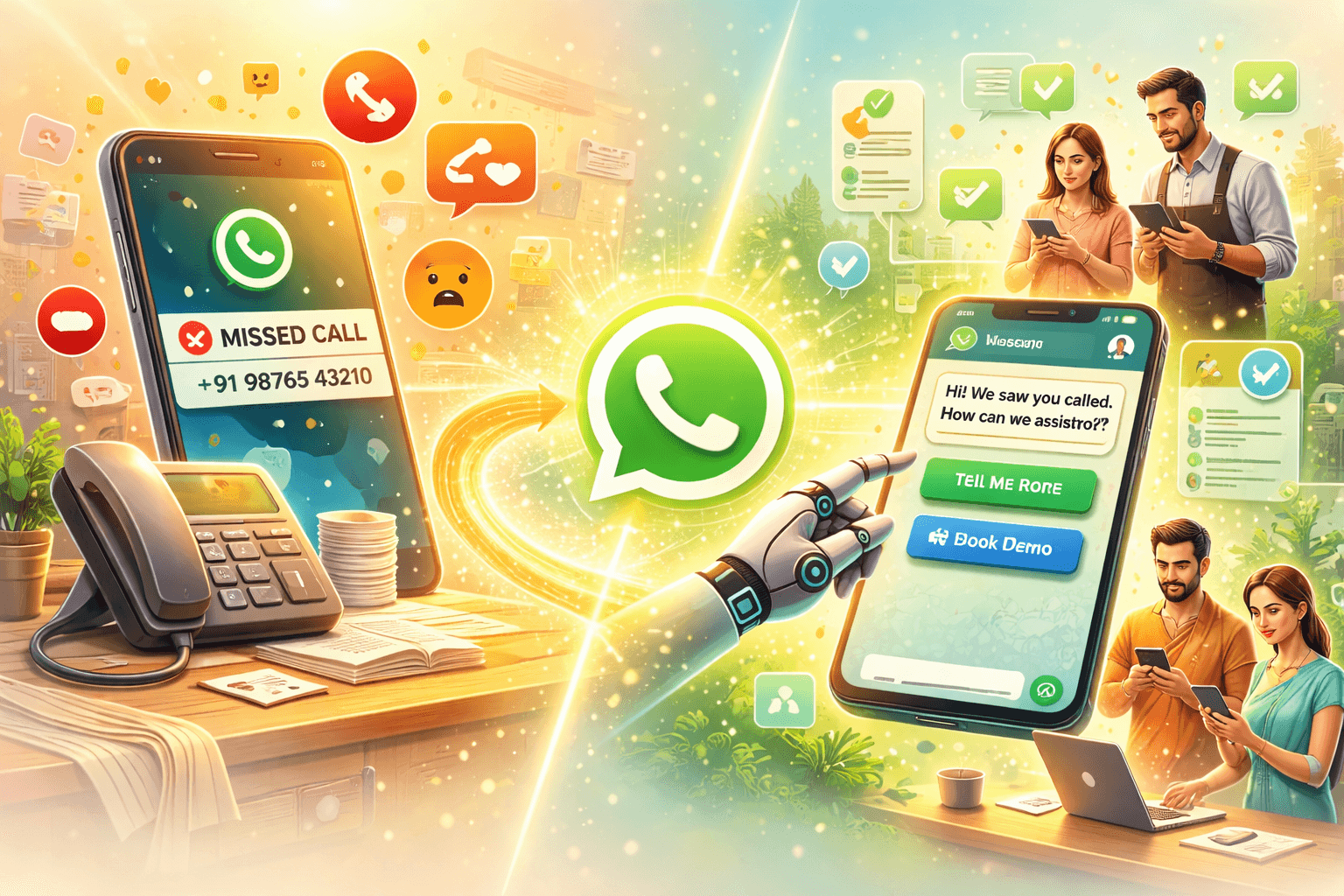
Missed call automation combined with WhatsApp solves this completely. The moment a missed call comes in, an automated WhatsApp message goes out to that number. Instantly. The conversation starts before the person has even put their phone down.
How Missed Call to WhatsApp Automation Actually Works
The setup is simpler than most people expect. Here is the basic flow:
Step 1: Someone calls your business number and the call either goes unanswered or is intentionally not picked up as part of a missed call campaign.
Step 2: Your system detects the missed call and captures the caller's number automatically.
Step 3: An automated WhatsApp message fires to that number within seconds. The message can introduce your business, ask a qualifying question, share a catalog link, or offer to connect them with your team.
Step 4: The person replies on WhatsApp, starting a conversation that your automation handles or hands off to a real person depending on what they need.
Step 5: The lead gets logged in your CRM with the WhatsApp conversation attached. Your sales team has full context and picks up a warm conversation instead of a cold callback.
The whole thing happens without anyone on your team lifting a finger. And it happens fast enough that the person still remembers why they called.
Speed matters more than most businesses realize. Research consistently shows that leads contacted within five minutes of showing interest are dramatically more likely to convert than leads contacted even 30 minutes later. A missed call to WhatsApp automation gets you there in under 10 seconds.
Why WhatsApp Is the Right Channel for Missed Call Follow-Up
You could automate a missed call follow-up over SMS. Or email. But neither of those channels comes close to WhatsApp for this use case.
SMS feels impersonal and one-directional. Email requires the person to be at a computer or actively checking their inbox. WhatsApp is where the conversation is already happening for most Indians. It is the default communication app. When your automated message lands there instantly, it feels like a natural continuation of the contact they just initiated, not an intrusion.
WhatsApp also gives you the ability to have a real back and forth conversation. You can ask questions, share images and brochures, send voice notes, and qualify the lead, all in the same thread. SMS simply cannot do this.
And because messaging is replacing landing pages as the primary conversion channel, the infrastructure you build for missed call follow-up on WhatsApp feeds into a much larger automation ecosystem for your business.
Real Businesses Using This Right Now
A Coaching Institute in Pune
A test prep institute was running radio ads with a missed call number. They were getting 200 to 300 missed calls a day. Their team of three could not possibly call everyone back. Most leads went cold by the time they got a callback, if they got one at all.
They set up missed call automation with a WhatsApp flow that fired instantly after every missed call. The message introduced the institute, asked which exam the student was preparing for, and offered a free demo class booking link.
Within the first week, they converted more leads from that single flow than they had in the previous month of manual callbacks. The automation handled the volume. The team only got involved when a lead was fully qualified and ready to talk.
A Real Estate Developer in Hyderabad
Property ads in India almost always include a "call for more details" number. The problem is that most calls come in during peak hours when the team is already busy. Missed calls pile up. By the time the evening callback round happens, half the prospects have moved on or called a competitor.
Missed call automation changed the follow-up game completely. Every missed call got an instant WhatsApp message with project details, a photo gallery link, and a question about budget and preferred configuration. Hot leads self-identified by replying with specifics. The sales team called those people back and had a much more productive conversation because the WhatsApp exchange had already done the initial qualification.
Setting Up Missed Call Automation: What You Need
Getting this running for your business involves a few components working together:
A virtual business number that can detect missed calls and trigger automations. This is typically a VoIP or cloud telephony number rather than a regular SIM-based number.
A WhatsApp Business API connection so your automation can send messages to any Indian mobile number. You cannot do this with the regular WhatsApp Business app at scale.
An automation platform that connects the missed call trigger to the WhatsApp message and manages the conversation flow. This is where conversation automation becomes the backbone of the entire system.
A CRM integration so every lead captured through the missed call flow gets logged automatically with the full WhatsApp conversation thread attached.
Wasupp connects all of these pieces. The WhatsApp API, the automation workflows, and the CRM sync all work together so you are not stitching together five different tools to make this happen.
What Your First WhatsApp Message Should Say
The first automated message after a missed call is the most important part of the entire flow. Get this right and your conversion rate goes up significantly.
Here is what works:
Acknowledge the call immediately. Something like "Hi, we noticed you called us just now." This confirms you are paying attention and the response is relevant to what they just did.
Introduce yourself briefly. One sentence about who you are and what you do. Not a sales pitch. Just context.
Ask one simple question. "What were you looking to know about?" or "How can we help you today?" One question. Not five. Keep the friction low.
Give them an easy next step. A quick reply option, a catalog link, or a booking link depending on your business type.
Here is an example for a coaching institute:
"Hi! We saw you called us a moment ago. We are [Institute Name], and we help students prepare for competitive exams. What exam are you preparing for? Reply here and we will get back to you right away."
Short. Warm. Specific. Easy to reply to.
For a product business, the message might share a catalog link and ask what product they were interested in. For a service business, it might offer to schedule a quick call at a convenient time. Tailor it to your customer journey.
Combining Missed Call Automation With Broadcast Campaigns
Once a missed call becomes a WhatsApp lead, that person is now in your ecosystem. Do not just have one conversation with them and let it go cold.
The follow-up sequence matters as much as the first message. If they did not convert on the first interaction, a well-timed follow-up message two or three days later can bring them back.
WhatsApp broadcast campaigns let you segment your leads and send targeted follow-ups based on where they are in the conversation. Leads who asked about pricing get a different message than leads who asked about features. Leads who went silent after showing interest get a gentle nudge. This is how you turn a list of missed call leads into an actual revenue pipeline.
Missed Call Automation for Small Businesses and Freelancers
You do not need to be a large business to benefit from this. Even if you get 10 missed calls a week, automating the follow-up saves you time and converts leads that would otherwise disappear.
For small business owners, WhatsApp automation means you are never off the clock from a lead response perspective. Your phone might be busy. Your team might be in a meeting. But the automation responds instantly, starts the conversation, and keeps the lead warm until a real person can take over.
For freelancers who get inquiries through ads or referrals, automating client communication on WhatsApp through missed call flows means you stop losing potential clients just because you were unavailable at the exact moment they decided to reach out.
A Note on WhatsApp Trust and Verification
When an automated message lands on someone's WhatsApp right after they missed a call, trust is established immediately because the context is clear. But if you want to push that trust even further, especially if you are running high-volume missed call campaigns, getting WhatsApp Blue Tick verification for your business number signals legitimacy to every new contact.
A verified business name next to your message means the person knows immediately they are talking to the real business, not a random number. Open rates and reply rates improve noticeably once you have the green tick.
FAQs: Missed Call to WhatsApp Lead Automation
Does the person need to have WhatsApp for this to work?
Yes. The follow-up message goes to WhatsApp, so the caller needs to have WhatsApp on the same number. In India, WhatsApp penetration is extremely high, especially among smartphone users, so this is rarely a problem in practice.
Can I use my regular business mobile number for missed call automation?
For small scale use, some setups work with regular numbers. But for reliable automation at any meaningful volume, a virtual business number connected to the WhatsApp Business API is the right approach.
What if someone calls intentionally and wants to speak to a person?
Your automation flow should always include an option to connect with a real person. Something as simple as "Reply 1 to speak with our team" gives callers an immediate human escalation path. Good automation knows when to step aside.
How fast does the WhatsApp message go out after a missed call?
With the right setup, the message fires within seconds of the call disconnecting. Most automation platforms trigger the WhatsApp message in under 10 seconds.
Is missed call automation compliant with WhatsApp's policies?
Yes, as long as you are using the official WhatsApp Business API and the person has initiated the contact by calling your number. Since they called you first, the opt-in argument is strong. That said, you should still include an opt-out option in your follow-up sequence. Always operate through a licensed solution provider to stay within WhatsApp's terms.
Can this work for a business getting only a few missed calls per day?
Absolutely. Even five missed calls a day is five potential leads you are currently not following up with fast enough. Automation makes every single one count.
How does the lead data get into my CRM?
When you use a platform like Wasupp, the missed call trigger, the WhatsApp conversation, and the lead data all sync to your CRM automatically. You get the caller's number, the full chat history, and any qualification data collected during the conversation, all in one place. This is what a proper messaging-first CRM setup for Indian businesses looks like in practice.
The Bottom Line
A missed call is not a lost lead. It is a lead that tried to reach you and just needs a faster, easier way to connect.
Missed call automation gives you that. The moment someone calls, WhatsApp takes over. The conversation starts instantly. The lead gets qualified automatically. Your team picks up a warm, informed conversation instead of making cold callbacks into the void.
For Indian businesses that already know the power of the missed call, this is the natural evolution. Stop calling back manually. Let automation do the first response, every time, in seconds.
Ready to set up your missed call to WhatsApp lead flow? Talk to the Wasupp team and we will get you running within the week