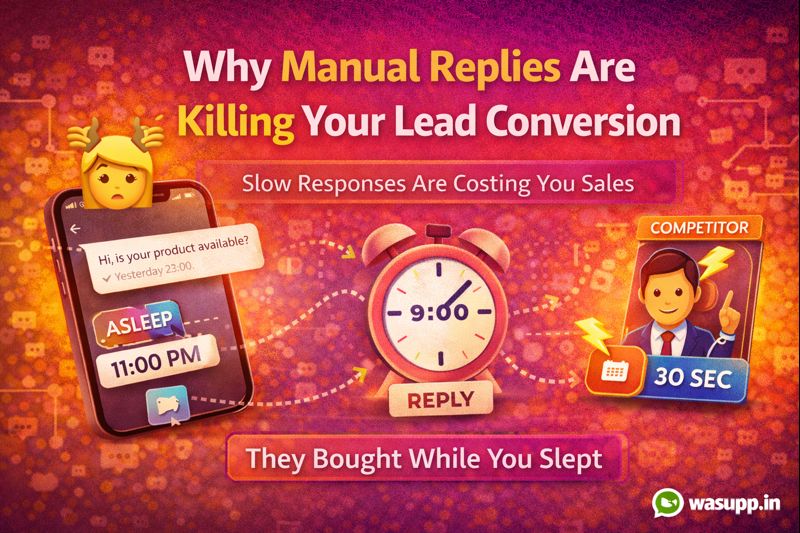
Someone messages you at 11 PM asking about your product. You're asleep. They need an answer now.
By the time you wake up and reply at 9 AM, they've already bought from your competitor who responded in 30 seconds.
You didn't lose because your product is worse. You didn't lose because your price is higher. You lost because you were too slow.
This is happening to your business right now. Every day. Multiple times a day. And you probably don't even realize how much money you're leaving on the table.
Let me show you exactly why manual replies are destroying your lead conversion and what you can do about it.
The Hard Truth About Response Time
There's a famous study that every business owner should know about. Harvard Business Review found that companies responding to leads within 5 minutes are 100 times more likely to connect than those waiting 30 minutes.
Read that again. One hundred times more likely.
Not 10% better. Not twice as good. One hundred times better.
And yet most businesses take hours or even days to respond to leads. Because they're doing it manually.
What Happens in the First 5 Minutes
When someone reaches out to you, they're in decision mode right now. They're comparing options. They're ready to move forward. They need answers.
The first business that responds and helps them gets the sale. It's that simple.
If you respond in 2 minutes, you look professional, responsive, and eager to help.
If you respond in 2 hours, you look busy, disorganized, or uninterested. Even if that's not true.
Perception becomes reality.
Your Competitors Are Responding Faster
While you're manually typing replies during business hours, your competitor has automation responding instantly at any time of day.
They're not smarter than you. They're not working harder than you. They just have better systems.
And they're winning because of it.
The Real Cost of Manual Replies
Let's break down what manual message handling is actually costing you.
Lost Leads You Never Knew About
You get a WhatsApp message at midnight. Another one at 6 AM. Two more during your lunch break. One while you're in a meeting.
By the time you see them, 3 of those 5 people have already moved on. They don't tell you. They just buy from someone else.
You look at your WhatsApp and think "Only 2 inquiries today." But it was actually 5. You just lost 3 before you even knew they existed.
Lower Conversion Rates on Leads You Do Reach
Even when you do respond, delayed responses kill conversion. Here's why:
Someone messages you excited about your product. You reply 4 hours later. Their excitement has faded. They're distracted with other things. The urgency is gone.
Now you have to re-engage them. Convince them all over again. Many won't even respond to your late reply.
Studies show that every hour of delay reduces conversion probability by 10%. After 24 hours, your conversion rate has dropped by over 60%.
Your Team Is Overwhelmed and Inefficient
Your team spends hours every day answering the same questions:
- "What are your prices?"
- "Do you deliver to [city]?"
- "What payment methods do you accept?"
- "How long does shipping take?"
These questions get asked 50 times per week. Your team types the same answers 50 times per week.
That's not productive work. That's wasted time that could be spent on actual sales conversations or customer support issues that need human judgment.
Inconsistent Messaging
Different team members answer the same question differently. One person says shipping takes 3-5 days. Another says 5-7 days. Someone else says "about a week."
Your customer gets confused. They wonder if you're disorganized or hiding something. Trust erodes.
Manual replies guarantee inconsistency because humans are inconsistent.
You Can't Scale
Right now you're handling 20 inquiries per day. What happens when it's 50? Or 100?
You either:
- Miss most of them
- Hire more people (expensive)
- Work 16-hour days (unsustainable)
Manual processes don't scale. They just create more chaos as you grow.
What Happens When You Automate
Let's flip the script. Here's what happens when you automate your initial responses:
Instant Acknowledgment Every Single Time
Someone messages you at 2 AM. They get an instant reply:
"Hey! Thanks for reaching out. I'm here to help. What can I do for you today?"
You're sleeping peacefully. They feel heard and helped. That lead doesn't go cold.
Qualification Happens Automatically
Your automation asks the right questions:
- "What product are you interested in?"
- "What's your budget range?"
- "When do you need this by?"
Based on their answers, hot leads get routed to your sales team immediately. Warm leads go into nurture sequences. Tire-kickers get helpful info but don't waste your team's time.
All of this happens whether it's 3 PM on Tuesday or 11 PM on Saturday.
Consistent Information Every Time
Every single person who asks about shipping gets the exact same accurate answer. No variation. No confusion.
Your brand looks professional and reliable because your messaging is consistent.
Your Team Focuses on High-Value Conversations
Instead of answering "What are your prices?" for the 47th time this week, your team is:
- Closing deals with qualified leads
- Solving complex customer problems
- Building relationships with high-value clients
- Working on strategy and growth
The repetitive stuff is automated. The important stuff gets human attention.
You Can Handle 10x the Volume
Automation doesn't get tired. Doesn't take breaks. Doesn't have a bad day.
Whether you get 10 inquiries or 1,000 inquiries, automation handles the initial response and qualification. Your team only deals with the subset that actually needs human involvement.
You scale without proportionally scaling headcount.
Real Example: The Cost of Manual Replies
Let me show you a real case study.
Urban Furniture is a boutique furniture store in Bangalore. Before automation, here's what their numbers looked like:
Manual reply process:
- 50 WhatsApp inquiries per day
- Team of 3 manually responding
- Average response time: 2.5 hours
- Only 60% of inquiries got a response
- Lead to sale conversion: 8%
- Monthly revenue: 18 lakhs
After implementing WhatsApp automation:
- 50+ inquiries per day (actually started getting more because word spread that they're responsive)
- Same team of 3
- Average response time: 30 seconds
- 100% of inquiries get instant acknowledgment
- Lead to sale conversion: 22%
- Monthly revenue: 38 lakhs
Same products. Same prices. Same team. The only difference was automation.
They more than doubled their revenue just by responding faster and more consistently.
The Psychology of Instant Responses
There's something deeper happening here than just speed.
Instant Response = You Care
When someone gets an immediate reply, the subconscious message is: "This business values me. They're responsive. They care about helping."
When someone waits hours for a reply, the message is: "I'm not a priority. They're probably too busy. Maybe I should look elsewhere."
Both might be completely wrong, but perception matters more than reality.
Momentum Matters
Decision-making has momentum. When someone is researching and comparing options, they want to keep moving forward.
Every delay breaks that momentum. Every wait creates an opportunity for them to get distracted, change their mind, or find someone else.
Automation keeps the momentum going.
Modern Expectations Have Changed
Ten years ago, people expected to wait for email responses. That was normal.
In 2026, people expect instant responses on messaging platforms. WhatsApp, Instagram, wherever they reach you.
If you don't meet those expectations, you're not just slow. You're outdated.
When Manual Replies Still Make Sense
Let me be clear: automation isn't about replacing humans. It's about handling the predictable, repetitive stuff so humans can focus on what actually needs a human touch.
Automate:
- Initial acknowledgments
- Common questions with clear answers
- Qualification questions
- Appointment booking
- Order status updates
- Payment confirmations
Keep human:
- Complex problem-solving
- Upset or frustrated customers
- High-value sales negotiations
- Custom requests
- Relationship building with key accounts
The goal isn't 100% automation. It's strategic automation that frees up your team for conversations that actually need human judgment and empathy.
How to Start Automating Without Losing the Personal Touch
If you're worried that automation will make you seem robotic, here's how to do it right:
Write Like a Human
Your automated messages should sound like you're actually texting someone, not sending a corporate memo.
Bad: "Thank you for your inquiry. We have received your message and will respond within 24 hours."
Good: "Hey! Just got your message. Let me help you out. What are you looking for?"
See the difference?
Use Personalization
Even automated messages should include:
- Their name (if you have it)
- Reference to what they asked about
- Natural conversation flow
"Hi Priya! Saw you're asking about our leather sofas. Here's what we have in stock..." feels personal even though it's automated.
Have Quick Human Handoff
When automation can't handle something or detects frustration, it should immediately route to a human.
"That's a great question. Let me connect you with someone who can give you detailed info on that."
Mix Automation with Human Check-Ins
Use automation for the logistics. Have humans do the relationship building.
Automation handles booking, reminders, and basic questions. Humans do the consultation call, answer complex questions, and close the deal.
Best of both worlds.
The ROI of Automating Your Replies
Let's talk money because that's what actually matters.
Time Savings
If your team spends 3 hours per day on repetitive messages, that's 90 hours per month. At a modest 500 rupees per hour, that's 45,000 rupees of time saved.
You can redeploy that time to revenue-generating activities.
Increased Conversion
If automation increases your lead to customer conversion from 10% to 15%, that's a 50% increase in sales from the same traffic.
Let's say you currently convert 100 leads per month at 10% = 10 customers. At 15% = 15 customers. That's 5 extra customers per month.
If your average customer value is 50,000 rupees, that's 2.5 lakhs in additional monthly revenue. 30 lakhs per year.
Most automation platforms cost 5,000-15,000 rupees per month. The ROI is obvious.
Better Customer Experience
Customers who get instant, helpful responses are more likely to:
- Complete their purchase
- Buy again in the future
- Refer others to you
- Leave positive reviews
The lifetime value of each customer goes up when you provide better experience.
Getting Started with Automation Today
You don't need to automate everything at once. Start small and build from there.
Step 1: Identify Your Most Common Questions
Look at your message history. What questions come up again and again?
Write down the top 10. These are your first automation targets.
Step 2: Write Natural Responses
For each common question, write a helpful response in your natural voice. Make it conversational and friendly.
Step 3: Set Up Basic Auto-Replies
Even just having an instant acknowledgment message makes a huge difference.
"Hey! Thanks for messaging. Give me just a moment and I'll help you out."
That's better than silence.
Step 4: Build Simple Workflows
Create basic if-then flows:
- If someone asks about pricing, send price list
- If someone asks about delivery, send delivery info
- If someone says they're ready to buy, send payment link
Start simple. Add complexity later.
Step 5: Monitor and Improve
Check what's working. What messages get good responses? Where do people drop off? What questions aren't being answered?
Continuously improve based on real data.
The Bottom Line
Every minute you delay in responding to a lead, your conversion probability drops.
Every repetitive question your team answers manually is time they could spend on high-value activities.
Every inconsistent message damages your brand.
Manual replies made sense 10 years ago. In 2026, they're actively costing you money and growth.
The businesses winning aren't working harder. They're working smarter. They're using automation to respond instantly, consistently, and at scale.
While their competitors are sleeping or busy, they're capturing leads, answering questions, and closing sales.
Ready to stop losing leads to slow response times? Let's build automation that converts more leads without losing the human touch.
FAQs
Won't automation make my business seem impersonal?
Only if you do it badly. Good automation sounds natural and conversational. Most customers don't care if the first response is automated as long as it's helpful and fast. And humans can jump in anytime for complex conversations.
How fast should I respond to be competitive?
Aim for under 5 minutes for initial acknowledgment. Under 1 minute is even better. Studies show response time directly correlates with conversion rates. The faster you respond, the more likely you are to close the deal.
What if automation can't answer a customer's specific question?
That's when it routes to a human. Good automation knows its limits and escalates complex questions to your team. Think of automation as the first line of response, not the only line.
Is automation expensive for small businesses?
Most automation platforms cost 2,000-15,000 rupees per month depending on features. Compare that to hiring another person at 30,000+ rupees per month. The ROI is clear, especially when you factor in increased conversion rates.
Can I automate WhatsApp, Instagram, and other platforms?
Yes. Modern automation platforms handle multiple channels from one dashboard. You set up your responses once and they work across WhatsApp, Instagram, Facebook, and more.
How do I measure if automation is working?
Track response time, conversation volume, conversion rate, and customer satisfaction. Compare these metrics before and after implementing automation. Most businesses see measurable improvement within the first month.
What's the biggest mistake businesses make with automation?
Making messages sound robotic or trying to automate too much. Keep automated messages conversational and natural. Use automation for repetitive t