Everyone's talking about AI automation. Your competitor claims they're using AI chatbots. Marketing emails are screaming about how AI will revolutionize your business.
But here's what nobody tells you: most businesses don't actually need AI automation. They need simple, reliable rule-based automation.
And spending money on fancy AI when rule-based automation would work better is like buying a Ferrari to drive to the grocery store. Sure, it sounds impressive, but it's overkill and you're wasting money.
Let me break down exactly what AI automation and rule-based automation actually are, when you need each one, and how to decide what's right for your business.
What Is Rule-Based Automation?
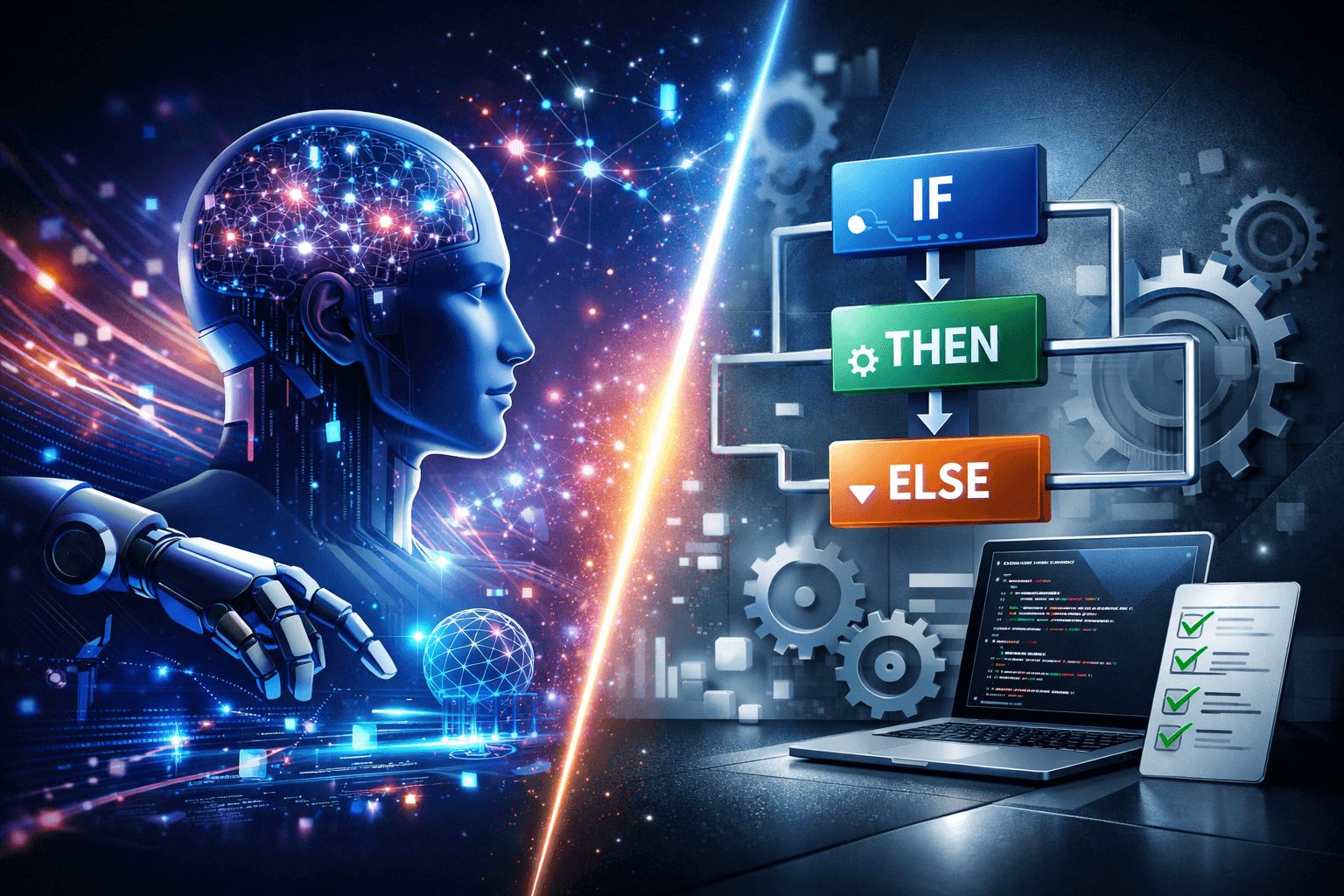
Rule-based automation follows simple if-then logic. You set specific rules, and the system follows them exactly every single time.
How Rule-Based Automation Works
Think of it like a flowchart:
If customer says "pricing" → Then send price list If customer says "delivery" → Then ask for their location If location is Mumbai → Then say "We deliver in 2 days" If location is outside Mumbai → Then say "Delivery takes 5-7 days"
You define every scenario. The automation executes exactly what you told it to do. No surprises. No interpretation. Just clear instructions.
Examples of Rule-Based Automation
Welcome messages: When someone messages you for the first time, send a greeting
Keyword responses: When someone types "hours," send your business hours
Appointment booking: Show available time slots, let them pick, confirm booking
Order tracking: When customer asks about order, look up order number and send status
FAQ answers: Match customer question to your pre-written answer
All of this is predictable, structured, and reliable.
What Is AI Automation?
AI automation uses machine learning and natural language processing to understand and respond to conversations more flexibly.
Instead of exact keyword matching, AI tries to understand intent and context.
How AI Automation Works
AI doesn't follow strict rules. It's trained on patterns and tries to figure out what the user means even if they phrase things differently.
Customer says: "How much does this cost?" AI understands: They're asking about pricing AI responds: Sends pricing information
Customer says: "What's the damage?" AI understands: They're also asking about price (slang) AI responds: Sends same pricing information
Customer says: "Do I need to sell my kidney to afford this?" AI understands: Still asking about pricing (humor) AI responds: Pricing information, maybe with a friendly response
The AI interprets meaning rather than matching exact words.
Examples of AI Automation
Natural language understanding: Understands questions phrased differently
Sentiment analysis: Detects if customer is frustrated or happy
Context awareness: Remembers what was discussed earlier in the conversation
Personalized responses: Adjusts tone and recommendations based on user behavior
Predictive suggestions: Anticipates what customer might need next
AI sounds impressive. And sometimes it actually is useful.
The Key Differences Between AI and Rule-Based Automation
Let's compare them directly.
|
Feature |
Rule-Based Automation |
AI Automation |
|
Setup Complexity |
Simple, drag-and-drop workflows |
Requires training and configuration |
|
Predictability |
Does exactly what you programmed |
Can give unexpected responses |
|
Accuracy |
100% accurate for defined scenarios |
80-95% accurate depending on training |
|
Cost |
Lower (5,000-15,000 rupees/month) |
Higher (20,000-50,000+ rupees/month) |
|
Maintenance |
Easy to update rules |
Needs ongoing training and monitoring |
|
Handling Variations |
Poor (exact keywords only) |
Good (understands different phrasings) |
|
Complex Conversations |
Limited |
Better at nuanced discussions |
|
Response Speed |
Instant |
Instant |
|
Failure Mode |
Says "I don't understand" |
Might misinterpret and give wrong answer |
Neither is objectively better. They're different tools for different jobs.
When Rule-Based Automation Is Better (Most Businesses)
Here's the truth: 80% of businesses should start with rule-based automation and might never need AI.
Your Customer Questions Are Predictable
If 90% of your customer inquiries fall into 10-15 categories, rule-based automation handles this perfectly:
- "What are your prices?"
- "Do you deliver to [city]?"
- "What are your hours?"
- "How do I track my order?"
- "Can I get a refund?"
You write answers to these once. Automation serves them forever.
You Want Complete Control
With rule-based automation, you know exactly what the bot will say in every situation. You wrote every response yourself.
No risk of the AI saying something weird, inappropriate, or off-brand.
For businesses where brand voice matters a lot, this control is valuable.
Your Budget Is Limited
Rule-based automation costs significantly less than AI automation. If you're a small business or just starting with automation, rule-based gives you 80% of the value at 30% of the cost.
You Need Reliability Over Flexibility
In industries like healthcare, legal, finance, or compliance-heavy sectors, you can't afford the bot giving wrong information because it misinterpreted something.
Rule-based automation only says what you explicitly programmed it to say. Safer.
Your Team Isn't Technical
Rule-based automation platforms have visual builders. If you can draw a flowchart, you can build automation.
AI automation often requires understanding of training data, confidence scores, and model tuning. More technical.
When AI Automation Is Better (Specific Use Cases)
There are scenarios where AI automation genuinely makes sense.
You Get Highly Varied Phrasing
If customers ask the same question 20 different ways, rule-based automation would need 20 different keyword triggers.
AI can understand all those variations without you programming each one.
Example: Asking about business hours could be phrased as:
- "What time do you open?"
- "When are you available?"
- "Are you open on Sunday?"
- "What's your schedule?"
- "When can I visit?"
AI handles all these without explicit programming.
You Need Contextual Awareness
AI can remember what was discussed earlier in the conversation and use that context.
Customer: "Do you have this in blue?" AI: "Yes, the [product they were just viewing] comes in blue."
Rule-based automation struggles with this kind of context switching.
You Have Complex Products That Need Recommendations
If you're selling complex products with many variables (like insurance, financial products, or custom solutions), AI can ask questions and recommend appropriate options based on responses.
This would require hundreds of rules to build manually.
You're Handling Multiple Languages
AI can often understand and respond in multiple languages better than rule-based systems, which would need entirely separate rule sets for each language.
You Want Sentiment Detection
AI can detect frustration, urgency, or satisfaction and route accordingly.
Angry customer gets routed to human support immediately. Happy customer stays with automation.
Rule-based systems can't reliably detect emotion.
The Hybrid Approach (Best of Both Worlds)
Here's what smart businesses actually do: they use both.
Rule-Based for Structure, AI for Understanding
Use rule-based automation for:
- Main conversation flows
- Critical business logic
- Payment processing
- Appointment booking
- Order management
Use AI for:
- Understanding customer intent initially
- Routing to the right rule-based workflow
- Handling unexpected questions
- Sentiment analysis for escalation
Example Hybrid Workflow
Step 1 (AI): Customer sends message. AI determines general intent: "They're asking about products."
Step 2 (Rule-Based): Route to product inquiry workflow. Ask: "Which product are you interested in? A, B, or C?"
Step 3 (Rule-Based): Based on selection, show specific product info, pricing, availability.
Step 4 (AI): If customer asks follow-up question that's not in your rules, AI interprets and provides best answer.
Step 5 (Rule-Based): When ready to buy, hand off to structured checkout workflow.
AI handles flexibility. Rules handle critical processes.
Real Example: E-Commerce Store's Automation Evolution
Let me show you how this plays out in reality.
Threads & Co, an online clothing store, started with pure manual responses. Then they evolved through different automation stages.
Stage 1: Pure Manual (Before Automation)
- Customer asks about product
- Team manually responds with details
- Back-and-forth about size, color, availability
- Manually send payment link
- Manually confirm order
Result: Could handle 20-30 orders per day max. Team burned out.
Stage 2: Basic Rule-Based Automation
Implemented simple WhatsApp automation:
If customer says "catalog" → Send product catalog link If customer says "order" → Ask which product If they select product → Show sizes, colors, price If they confirm → Send payment link
Result: Handling 80-100 orders per day. Much better.
Stage 3: Problems with Pure Rule-Based
Customers started asking questions in ways the rules didn't catch:
Customer: "Got anything in XL?" Bot: "I don't understand."
Customer: "Show me dresses" Bot: "I don't understand." (Because the keyword was "catalog" not "dresses")
Result: Frustrated customers. Team still manually handling 30% of conversations.
Stage 4: Hybrid AI + Rule-Based (Current)
Added AI layer on top of rule-based workflows:
AI interprets customer intent: "They want to see products" Rules take over: Show catalog, collect selection, process order AI handles unexpected questions: "What fabric is this?" gets answered even though no rule exists Rules handle checkout: Payment, confirmation, shipping
Result: Handling 200+ orders per day with same team size. Customer satisfaction up. Fewer manual interventions.
The hybrid approach won.
How to Decide What Your Business Needs
Here's a simple decision framework:
Start With These Questions
Q1: