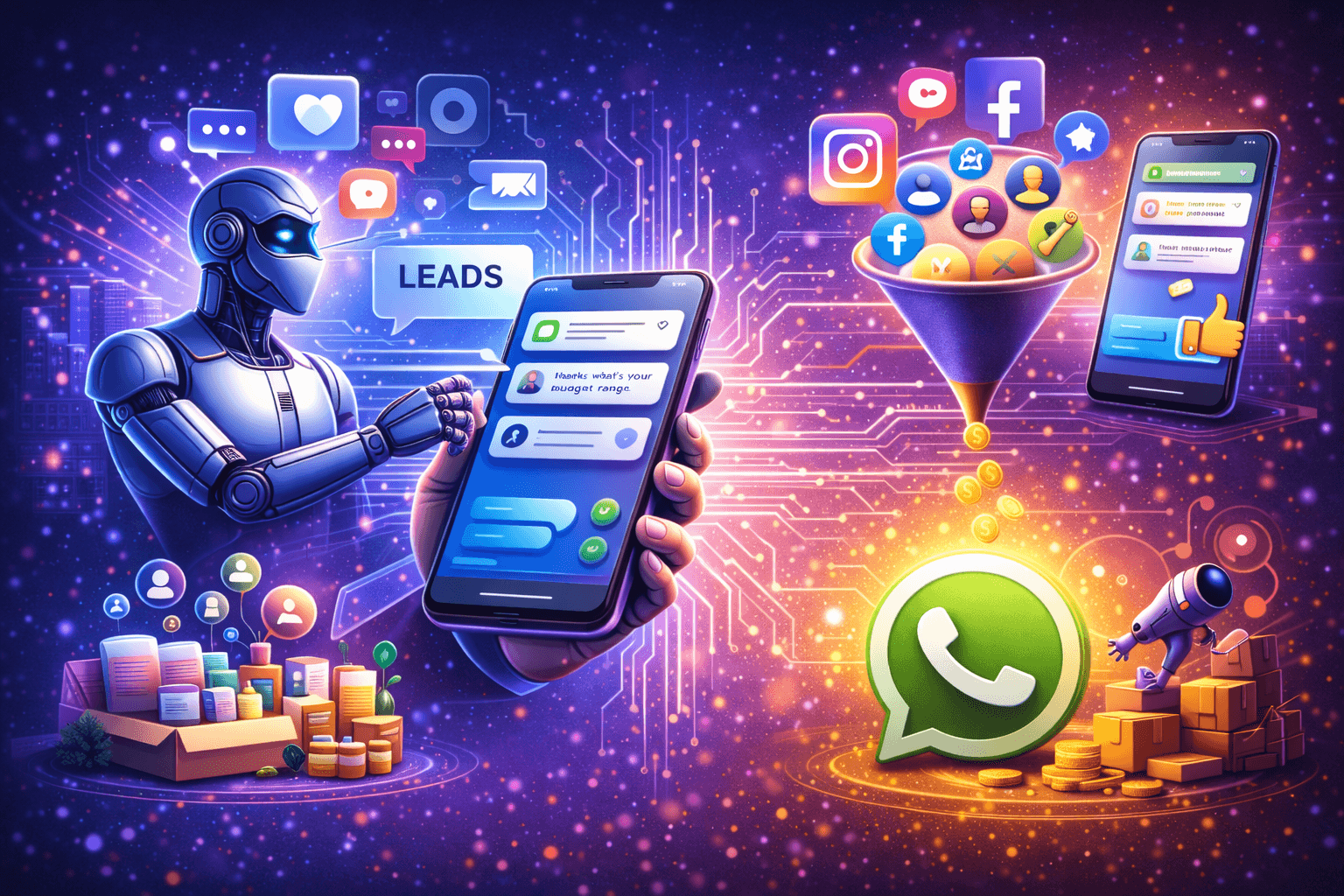
Picture this. You wake up on Monday morning. While you were sleeping, your Instagram handled 150 comments, sent personalized DMs to everyone who engaged with your reel, captured 40 leads, and moved 12 of them into your WhatsApp sales funnel.
Your team didn't do any of that. Automation did.
This isn't some distant future scenario. This is happening right now for businesses that have figured out where social media management is headed.
And the businesses still doing everything manually? They're working twice as hard for half the results.
Let me show you exactly where social media management is going, why automation is driving that future, and how to position your business to win.
Why Manual Social Media Management Is Breaking Down
Before we talk about the future, let's be honest about the present.
If you're managing social media manually, your day probably looks something like this:
Check Instagram comments. Reply to some. Miss others. Check DMs. Same messages you answered yesterday from different people. Post content. Check WhatsApp. Answer the same questions again. Try to keep up with Facebook. Realize you forgot to respond to three Instagram DMs from yesterday.
By the end of the day, you've spent 4-5 hours on social media management. You haven't created any new content. You haven't worked on strategy. You've just been reacting.
The Volume Problem
Social media volumes are increasing faster than teams can grow.
A reel that goes semi-viral gets 500 comments. You can respond to maybe 50 manually. The other 450 people who engaged? They never hear from you.
Every unanswered comment is a missed conversation. Every missed conversation is a missed sale.
The Speed Problem
Someone comments on your post at 9 PM asking about your product. You're putting your kids to bed. You see it at 9 AM. By then, they've already bought from your competitor who responded at 9:01 PM automatically.
Speed is no longer a competitive advantage. It's the baseline expectation.
The Consistency Problem
Your social media response quality depends on who's working that day, how tired they are, and how much coffee they've had.
Some days you're witty and helpful. Other days you're short and generic.
Automation is consistent every single time.
The Scaling Problem
Your social media presence grows. More followers. More engagement. More messages.
But your team doesn't grow at the same rate. The math doesn't work without automation.
What Social Media Automation Actually Means
Let's clear up a common misconception. Social media automation isn't about replacing human creativity.
You still need humans to:
- Create original, compelling content
- Build genuine relationships with key followers
- Handle sensitive customer situations
- Make strategic decisions
- Develop your brand voice
Automation handles:
- Initial responses to common questions
- Lead capture and qualification
- Routing conversations to the right person
- Follow-up sequences
- Data collection and reporting
- Repetitive engagement tasks
Think of automation as your backstage crew. You're still the performer. They just handle the logistics.
The Key Trends Shaping the Future of Social Media Automation
Trend 1: DM Automation Becomes the Primary Sales Channel
The shift is already happening. Instagram DM automation and WhatsApp automation are becoming primary sales tools, not just support channels.
Here's the pattern:
- Content attracts attention
- Comments signal interest
- Automation converts that interest into DM conversations
- DM conversations become sales
The sales funnel now runs entirely through messaging apps.
Businesses figuring this out are converting 10-15% of their social media engagement into actual revenue. Businesses still directing everyone to their website are converting 2-3%.
Trend 2: Comment-to-DM Automation Goes Mainstream
If you've been on Instagram recently, you've seen it. Creator posts: "Comment GUIDE to get my free resource." You comment. Seconds later, a DM appears.
This wasn't possible at scale without automation. Now it's becoming standard practice.
Why does this matter? Because it transforms passive engagement into active conversation. You go from being someone who liked a post to someone actively talking to the brand.
The businesses that implement this now have first-mover advantage. As it becomes mainstream, early adopters will have refined their workflows while competitors are just getting started.
Trend 3: Omnichannel Automation Replaces Single-Platform Thinking
The question used to be "should we focus on Instagram or WhatsApp?" Now the question is "how do we connect them seamlessly?"
The future is omnichannel. Someone discovers you on Instagram. Moves to WhatsApp for serious conversation. Gets their question answered. Makes purchase. Gets order updates on WhatsApp. Sees remarketing on Instagram. Comes back for second purchase.
Automation connects all these touchpoints into one coherent customer journey.
Businesses managing these channels separately with different tools and no connection between them are already behind.
Trend 4: Personalization at Scale Becomes Expected
"Hi there!" is dead. Your customers want messages that feel personal even when you're talking to thousands of them.
Automation is making this possible. Dynamic fields, behavioral triggers, purchase history, browsing behavior. All feeding into personalized communication at scale.
Soon, sending generic automated messages will be as obvious and unprofessional as sending a handwritten letter with no name on it.
Trend 5: Messaging Funnels Replace Traditional Marketing Funnels
The old funnel: Ad → Website → Form → Email sequence → Sale
The new funnel: Content → Comment → DM Automation → WhatsApp conversation → Sale
Messaging funnels are shorter, more personal, and convert better. The move away from websites and forms toward direct conversation is accelerating.
Every month that passes, more businesses are replacing their landing pages with WhatsApp links and Instagram DM funnels.
Trend 6: AI-Powered Automation Gets Smarter
Automation is getting better at understanding context and intent. It's not just matching keywords anymore.
When a customer types "I need something for my sensitive skin," automation can understand they need a product recommendation, ask clarifying questions, and recommend the right product based on their answers.
This type of intelligent conversation will become standard, not premium.
Trend 7: Social Commerce Runs Through Messaging
Shopping through Instagram DMs and WhatsApp is growing rapidly in India. Discover product → ask question → get recommendation → buy → receive update. All in one conversation thread.
No website needed. No checkout page. No form filling.
The businesses building their commerce infrastructure around messaging are positioning for where customers are going, not where they've been.
What This Means for Your Business Right Now
The trends are clear. But how does this translate to what you should actually do?
If You're Just Starting
You don't need everything. Start with one automation that solves your biggest problem.
Getting lots of Instagram comments but not converting? Set up comment-to-DM automation.
Getting WhatsApp inquiries you can't respond to fast enough? Set up instant response automation.
Getting leads but not following up consistently? Set up automated follow-up sequences.
One automation, done well, beats ten automations done poorly.
If You're Established
You're probably already doing some automation. The question is whether it's strategic or patchwork.
Map your entire customer journey across all social platforms. Identify every gap where automation could improve speed, consistency, or conversion.
Then systematically fill those gaps with connected automation that passes context between platforms.
If You're Scaling
At scale, automation isn't optional. It's infrastructure.
You need full omnichannel automation with CRM integration, analytics, and continuous optimization.
The good news? The businesses that built this infrastructure early are nearly impossible to compete with manually.
The Specific Automations Defining Social Media's Future
Let's get practical. Here are the automation types that matter most right now.
Comment Management Automation
Not just responding to comments. Using comments as lead generation triggers.
Post about your product. Someone comments "How much?" Automation DMs them pricing AND starts a conversation.
Every comment becomes an opportunity instead of just a metric.
Story Interaction Automation
Someone votes on your poll. Replies to your story. Mentions you in their story.
Automation acknowledges and starts conversation based on their specific interaction.
Someone voted "Yes" on your poll about needing more energy? Automation DMs: "Saw you voted yes! Our energy supplement might be exactly what you need. Want to know more?"
Cross-Platform Lead Transfer
Instagram captures interest. WhatsApp closes sales.
Automation detects when someone in Instagram DMs is a serious prospect and seamlessly invites them to continue on WhatsApp with full context transfer.
They don't have to repeat themselves. You don't lose context. Conversion improves dramatically.
Behavioral Trigger Automation
Someone views your product 3 times on Instagram. Automation detects repeated interest and sends a personalized DM: "Noticed you've been checking out [product]. Questions? I can help."
This felt impossible before automation. Now it's table stakes for serious social commerce brands.
Automated Social Listening
Automation monitors mentions, hashtags, and relevant keywords. When someone mentions a problem your product solves, automation can engage proactively.
You're not waiting for customers to come to you. You're finding them where they're already talking.
How Indian Businesses Are Adopting Social Media Automation
India is actually ahead of many markets in social media automation adoption. Here's why:
WhatsApp penetration: With 500+ million users, India has the infrastructure for messaging-first business.
Social commerce culture: Indians are comfortable buying through Instagram and WhatsApp. The behavior is already there.
Digital native customers: India's growing middle class and young population expect digital, instant communication.
Competitive markets: In competitive Indian markets, speed and availability become differentiators fast.
The businesses in India winning on social media in 2026 are the ones that understood this early and built automation infrastructure.
Building Your Automation Stack for the Future
Here's how to future-proof your social media management.
Layer 1: Instant Response (Foundation)
Every platform you're on should have instant response capability.
New Instagram DM? Instant acknowledgment. New WhatsApp inquiry? Instant response. New comment? Immediate relevant DM.
This is the minimum. Without this, you're already behind.
Layer 2: Conversation Flows (Qualification)
Beyond just responding, you need structured conversations that qualify leads and gather information.
What are they looking for? What's their budget? What problem are they solving?
Automation gathers this so humans spend time on sales-ready conversations, not preliminary qualification.
Layer 3: Cross-Platform Connection (Integration)
Your Instagram automation and WhatsApp automation should talk to each other.
Lead captured on Instagram? Information passes to WhatsApp automatically. Context preserved. No repetition.
Layer 4: CRM Integration (Intelligence)
Everything feeds into your CRM. Every interaction, every platform, every customer.
Your team sees full customer history regardless of which platform they came from.
Layer 5: Analytics and Optimization (Improvement)
Continuous data on what's working. Which messages convert best? Which platforms drive most qualified leads? Where do people drop off?
Use this to continuously improve your automation.
The Businesses That Won't Survive the Shift
Let's be direct. Some businesses will struggle to adapt.
Businesses relying on organic reach alone: Algorithm changes will hurt them without automation amplifying their engagement.
Businesses with slow response times: As competition gets faster, slow responders lose more and more leads.
Businesses on single platforms: Customers move between platforms. Single-platform businesses lose them in the gaps.
Businesses without data: Making decisions without analytics means wasting budget and effort.
Businesses treating automation as optional: In 2-3 years, not having automation will be like not having a website was in 2005.
The Businesses That Will Win
Businesses with omnichannel presence: They catch customers wherever they are.
Businesses with instant response: They never miss a lead regardless of time or volume.
Businesses with personalized automation: They feel small and personal even when operating at scale.
Businesses with data-driven optimization: They get better every month while competitors guess.
Businesses that start now: Every month of early adoption is a competitive advantage that compounds.
The Bottom Line
Social media management is shifting from manual labor to automated intelligence.
The platforms are building the tools. The customer behavior is already there. The technology is accessible. The only question is whether you'll adopt it early or scramble to catch up later.
The businesses reading this in 2030 and wondering "why didn't we do this sooner?" are the ones that treated automation as optional today.
The ones thriving? They're building the infrastructure now while competitors are still doing things manually.
Ready to build social media automation that positions your business for where things are going? Let's create an automation strategy that fits your platforms, audience, and growth goals.
FAQs
Will automation replace social media managers?
No. Automation handles repetitive, high-volume tasks. Social media managers focus on strategy, creative direction, relationship building, and complex situations that require human judgment. The role evolves rather than disappears.
Is social media automation expensive?
It varies significantly by platform and features. Basic automation starts at a few thousand rupees per month. Enterprise solutions cost more. But the ROI is typically strong since you're converting more leads from existing traffic.
Can automation maintain authentic brand voice?
Yes, if implemented properly. You write the automated messages in your brand voice. Good automation feels natural and personalized. The key is quality message writing, not just the technology.
How do I know if my automation is working?
Track key metrics: response rates, lead conversion rates, engagement rates, sales from social media. Compare before and after automation implementation. Most businesses see measurable improvement within 30-60 days.
Is automation allowed on all social platforms?
Each platform has its own policies. Instagram and WhatsApp support automation through official APIs and approved partners. Using unofficial tools risks account suspension. Always use legitimate, API-compliant automation.
How much of social media management can actually be automated?
Roughly 60-70% of social media management tasks can be automated. Content creation, complex strategy, and relationship building with key partners still require humans. The repetitive, high-volume communication tasks are automation's sweet spot.
What's the biggest mistake businesses make with social media automation?
Setting it up and forgetting it. Automation needs regular review and optimization. Customer questions evolve, offers change, products update. Stale automation gives wrong information and frustrates customers.
Should I automate all platforms simultaneously?
No. Start with your highest-volume platform. Master that. Then add others. Trying to automate everywhere at once usually results in mediocre automation on every platform.