You've been told you need a website to run a real business. Landing pages. Shopping carts. Checkout systems. The whole thing.
But here's the truth: thousands of businesses in India are making serious money without touching a website builder. They're running entire sales funnels through WhatsApp.
No hosting fees. No website maintenance. No learning WordPress or dealing with broken plugins. Just WhatsApp and smart automation.
If you've been putting off launching because building a website feels overwhelming, this is your way out. Let me show you exactly how to build a complete WhatsApp sales funnel that converts strangers into paying customers.
What Is a WhatsApp Sales Funnel?
A sales funnel is just the path someone takes from "I don't know you" to "Here's my money."
Traditional funnels use websites:
- See an ad
- Click to landing page
- Fill out a form
- Get emails
- Eventually buy
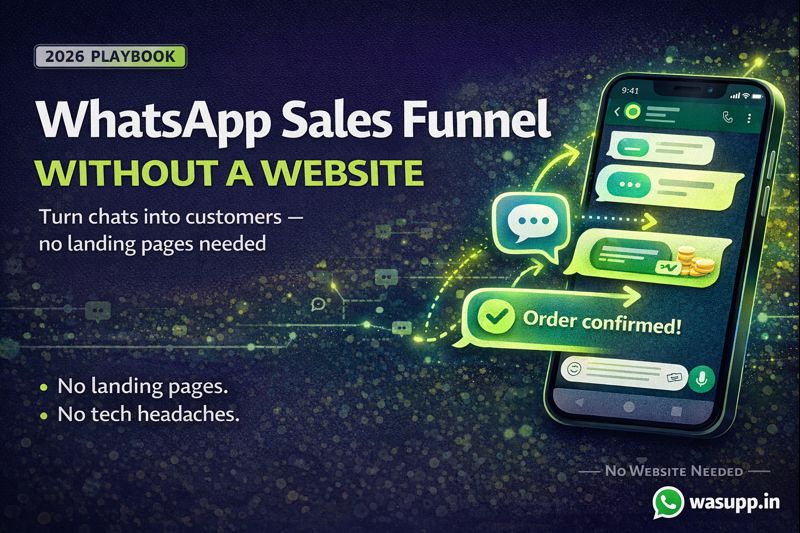
A WhatsApp sales funnel skips all that:
- See an ad or post
- Click to WhatsApp
- Start a conversation
- Get qualified automatically
- Receive product info and payment link
- Buy directly through WhatsApp
Everything happens in one app. The app your customers already use every day.
Why This Works Better Than Traditional Funnels
WhatsApp messages have a 98% open rate. Your website probably has a 2-5% conversion rate.
When someone lands on your website, they're one distraction away from leaving. When someone's talking to you on WhatsApp, you have their full attention.
Plus, there's no technical barrier. Your grandmother can message you on WhatsApp. Not everyone can navigate a checkout page.
Why You Don't Actually Need a Website
Let's kill this myth right now: websites are optional, not mandatory.
Websites Are Expensive and Complicated
Building a decent website costs anywhere from 20,000 to 2 lakh rupees. Then there's hosting, domain renewals, security updates, and fixing things when they break.
For a small business just starting out, that's a massive investment before you've even proven your product works.
WhatsApp is free. WhatsApp Business API costs way less than a website. And it's way easier to set up.
Most Indian Customers Prefer WhatsApp Anyway
Your customers are already on WhatsApp. They're comfortable with it. They trust it.
When you send them to a website, you're adding friction. When you keep them on WhatsApp, everything feels natural and easy.
Websites Create Distance
A website is impersonal. It's you talking at someone through a screen.
WhatsApp is a conversation. It's two-way. You can answer questions in real time, build trust, and handle objections immediately.
That personal connection closes way more sales than any fancy website ever will.
You Can Always Add a Website Later
Start with WhatsApp. Prove your business model. Make money. Then if you really want a website for credibility or SEO, build one.
But you'll probably realize you don't actually need it.
The Complete WhatsApp Sales Funnel Blueprint
Here's the exact structure that's working for businesses right now:
Stage 1: Awareness (Getting People to Message You)
You can't sell to people who don't know you exist. First step is getting them into your WhatsApp.
How to drive traffic to WhatsApp:
Instagram and Facebook posts: Use comment-to-DM automation to capture interested people, then move them to WhatsApp for the actual sale
Click-to-WhatsApp ads: Run Facebook or Instagram ads where the CTA button opens WhatsApp directly
WhatsApp QR codes: Print them on flyers, business cards, storefronts, anywhere your target customers will see them
Link in bio: Put your WhatsApp link in your Instagram, Facebook, or LinkedIn bio
Google My Business: Add your WhatsApp number so people searching for your business can message you directly
The goal here is simple: make it ridiculously easy for interested people to start a conversation with you.
Stage 2: Interest (Qualifying the Lead)
Someone messages you. Great. But are they actually interested or just browsing?
Your WhatsApp automation asks qualifying questions:
"Hey! Thanks for reaching out. Quick question: are you looking for [Product A] or [Product B]?"
Based on their answer, the conversation branches. You're not treating everyone the same. You're personalizing based on what they actually want.
Follow-up questions might be:
- What's your budget range?
- When do you need this by?
- Have you tried something similar before?
These aren't pushy sales questions. They're helping you understand how to best help them.
Stage 3: Consideration (Building Trust and Providing Value)
They're interested. Now you need to build trust.
This is where you share:
- Product photos or videos
- Customer testimonials
- Case studies or before/after examples
- Detailed specifications or features
- Answers to common objections
All through WhatsApp. Images, videos, PDFs, voice notes, whatever format works best.
The beauty of WhatsApp is you can read their vibe. If they're asking lots of questions, they need more information. If they're saying "looks good," they're ready to buy.
Traditional funnels can't adapt like this.
Stage 4: Decision (Making the Sale)
They're ready. Time to close.
Send them:
- Final price (including any current discounts)
- Payment link (UPI, Razorpay, Instamojo, whatever you use)
- Clear next steps after payment
Make it stupid simple. "Here's the link. Pay whenever you're ready. Once payment comes through, I'll get your order moving."
Stage 5: Action (Processing and Delivery)
They paid. The sale is done. But the funnel isn't over.
Automation handles:
- Payment confirmation message
- Order details and timeline
- Shipping updates (if physical product)
- Delivery confirmation
- Post-purchase check-in
This is where websites actually create more work. You'd need to set up email automations, integrate shipping APIs, and manage everything from multiple dashboards.
On WhatsApp, it's all in one conversation thread.
Stage 6: Retention (Turning Customers into Repeat Buyers)
This is the stage most businesses ignore. Big mistake.
After someone buys from you once, they're 60-70% more likely to buy again compared to a cold lead.
Use WhatsApp broadcasts to:
- Share new products
- Announce sales or promotions
- Provide helpful tips related to what they bought
- Ask for referrals
Your existing customers are your best source of future revenue. Don't forget about them after one sale.
Real Example: How a Homemade Food Business Runs Entirely on WhatsApp
Let me show you how this works in practice.
Kavya makes homemade pickles in Chennai. No website. No storefront. Just WhatsApp.
Her funnel:
Awareness: She posts recipe videos on Instagram with "Order homemade pickles, link in bio." Her bio has a WhatsApp link.
Interest: Someone clicks the link and messages her. Automation immediately asks: "Hey! Which pickle are you interested in? Mango, lemon, or mixed?"
Consideration: Based on their choice, automation sends:
- Photos of that specific pickle
- Ingredients list
- Pricing for different jar sizes
- Screenshot of recent customer reviews
- "Any questions about ingredients or spice level?"
Decision: When they're ready, automation sends: "Awesome! Here's the payment link. Once you pay, I'll get your order packed today."
Action: After payment:
- Confirmation message with order details
- "Your pickle is packed and will be delivered by [date]"
- Delivery confirmation
- "How's the pickle? Would love to know what you think!"
Retention: Every month, Kavya broadcasts to past customers: "New batch of seasonal mango pickle just made. Want your usual or trying something new?"
She's doing 50-60 orders per week. All through WhatsApp. Zero website. Making over 2 lakh rupees per month in revenue.
Tools You Need for a WhatsApp Sales Funnel
You don't need much, but you do need the right things:
WhatsApp Business API
The free WhatsApp Business app is fine when you're just starting. But to really scale and automate, you need API access.
This lets you:
- Handle unlimited conversations
- Set up automation and chatbots
- Send broadcast messages to thousands
- Integrate with payment systems
- Get analytics on performance
You can't get API access directly from WhatsApp. You need to go through an approved Business Solution Provider.
Automation Platform
You need software to build your conversation flows and automation. Look for platforms that offer:
- Visual workflow builders (no coding)
- WhatsApp API integration
- Payment link integration
- Broadcast messaging
- Contact management
- Analytics
At Wasupp, we built our platform specifically for businesses that want to run sales funnels through messaging without needing technical skills.
Payment System
You need a way to collect money. Options include:
- UPI (simplest for Indian customers)
- Payment gateway like Razorpay or Instamojo
- WhatsApp Pay (when available in your region)
- Bank transfer (though this is slower)
The easier you make it to pay, the more sales you close.
Product Catalog
Even without a website, organize your products. Create:
- Clear product photos
- Simple price lists
- Product descriptions
- FAQ documents
Store these as easily shareable files that automation can send when needed.
Step-by-Step: Setting Up Your First WhatsApp Sales Funnel
Let's get practical. Here's how to actually build this:
Step 1: Get Your WhatsApp Business Set Up
Start with the free WhatsApp Business app to test your concept. Once you're getting regular sales, upgrade to API for automation.
Create a professional profile:
- Business name
- Logo or profile photo
- Description of what you sell
- Business hours
- Location (if relevant)
Step 2: Map Your Customer Journey
Write out the exact path you want customers to take:
- Where do they first hear about you?
- What makes them message you?
- What questions do they typically ask?
- What objections do they raise?
- What info do they need before buying?
- How do they prefer to pay?
Understanding this journey helps you build better automation.
Step 3: Create Your Conversation Scripts
Write out the messages for each stage:
- Welcome message
- Qualifying questions
- Product information responses
- Objection handlers
- Payment instructions
- Confirmation messages
- Follow-up messages
Keep them conversational. Write how you'd actually talk to a friend, not corporate speak.
Step 4: Build Your Automation Workflows
Using your automation platform, create flows:
- If someone says X, send Y
- If someone asks about pricing, send price list
- If someone says they're interested, send payment link
- If payment confirmed, send order confirmation
Start simple. You can add complexity later.
Step 5: Set Up Your Traffic Sources
Decide how people will find you:
- Instagram posts with WhatsApp link?
- Facebook ads clicking to WhatsApp?
- QR codes on physical materials?
- Referrals from existing customers?
You need at least one consistent traffic source.
Step 6: Test Everything
Before you go live, test your entire funnel:
- Message yourself as if you're a customer
- Make sure automation responds correctly
- Check that payment links work
- Confirm confirmation messages send
Fix anything that breaks or feels weird.
Step 7: Launch and Monitor
Go live. Drive traffic. Watch what happens.
Check daily:
- How many people are messaging?
- Where are they dropping off?
-
Share this post